
The Hungarian Ministry of Finance has submitted the draft of Hungarian wealth tax bill for public consultation. According to the draft legislation – in line with previous communications – a tax liability may arise on the basis of the wealth position as of 31 December 2026. The tax liability would extend to the worldwide assets of Hungarian tax resident individuals and asset management structures, as well as the Hungarian-related assets of non-resident individuals and asset management taxpayers. According to preliminary government calculations, the wealth tax could generate up to HUF 800 billion in revenue for the Hungarian state budget.
Who may be affected and what could be the rate of the wealth tax?
Based on the bill, the Hungarian wealth tax could primarily affect individuals and asset management taxpayers holding significant net taxable assets.
- Affected taxpayers: Individuals and asset management taxpayers
- Threshold: Net taxable assets exceeding HUF 1 billion
- Tax rate: 1%; 1.5% on the portion of the tax base exceeding HUF 100 billion
- Estimated number of affected taxpayers: 15,000 individuals + 2,000 asset management taxpayers
For a Hungarian tax resident individual, the tax base is simplified as the calculated value of taxable assets minus properly verified deductible debts under the law, for the portion exceeding HUF 1 billion. The wealth position should, as a general rule, be examined on 31 December of each year in Hungary. The deadline for filing the tax return and paying the tax would be 31 August of the year following the tax year.
How should equity investments be valued for Hungarian wealth tax purposes?
Listed companies
In the case of shareholdings in companies listed on a stock exchange or regularly traded over-the-counter, the Hungarian wealth tax draft would fundamentally apply valuation based on market prices.
Unlisted companies
For unlisted private companies, the Hungarian wealth tax bill would introduce a complex calculation method combining equity and earning capacity. Accordingly, equity appears with a one-third weighting, while yield value reflecting the company’s income-generating capacity is weighted at two-thirds in the calculated value of the shareholding. The latter should generally be determined based on the average after-tax profit of the last three closed financial years, using a 15% capitalization rate. The calculation logic is illustrated by the following two examples:
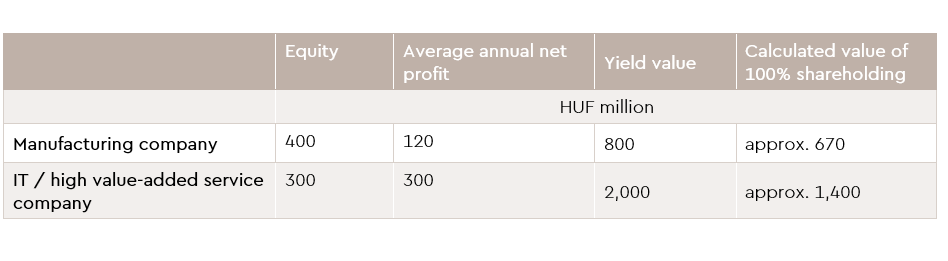
These examples clearly show that under the valuation prescribed by the Hungarian wealth tax bill, the balance sheet total or equity of an enterprise is not the sole decisive factor: sustainable earning capacity may have a significantly greater impact on the calculated value of an equity holding for wealth tax purposes. For Hungarian companies with equity exceeding HUF 500 million, hidden reserves must also be taken into account as an additional adjustment. Examples include the positive difference between the market value and the book value of real estate, shareholdings, or securities.
Holding companies
In the case of a holding company, the Hungarian wealth tax draft applies a simpler valuation logic. If company assets consist of at least 90% shareholdings, yield value does not need to be separately considered. The calculated value of the shareholding would, as a general rule, equal the equity corresponding to the ownership share. For example, for a holding company with HUF 1.2 billion in adjusted equity 100% owned by an individual, the calculated value of the shareholding would also be HUF 1.2 billion. However, it is important to note that if equity exceeds HUF 500 million, the Hungarian wealth tax bill may also require equity to be increased by hidden reserves, meaning the actual value considered for wealth tax purposes could be higher.
Valuation of real estate in the Hungarian wealth tax
Real estate in Hungary
For Hungarian domestic real estate, the draft establishes a strict hierarchical order among valuation methods:
- First, the transaction value relating to the property within the past 12 months must be used as a baseline,
- in the absence thereof, the indexed amount of an earlier transaction value dating back up to ten years,
- then the value derived from the nationwide mass real estate valuation model of the Hungarian tax authority,
- and finally, an independent expert market valuation may be applied.
In certain cases, an expert valuation may substitute a preceding valuation method in the ranking. For residential properties, indexing would be based on the residential property price index of the National Bank of Hungary, while for agricultural land, it would rely on the agricultural land price data of the Central Statistical Office.
Foreign real estate
According to the Hungarian wealth tax bill, foreign real estate owned by a Hungarian tax resident individual would also fall under the scope of the new tax. However, for this asset class, the transaction or official value at acquisition should serve as the starting point, modified in subsequent years at the taxpayer’s choice by 3% annually or by the official real estate price index of the country where the property is located. If the acquisition value cannot be established, foreign cadastral or other official values, or ultimately an independent expert valuation may be applied. The double taxation treaty must be examined individually in every case if its substantive scope covers wealth tax.
Valuation of other assets
In case of movable and other assets, , as a general rule, they should be valuated from the fair market value existing on the last day of the tax year. However, tangible assets used for everyday personal purposes generally do not need to be taken into account, with specific exceptions such as:
- works of art, collections, and jewellery with an individual value exceeding HUF 3 million,
- and vehicles exceeding HUF 10 million in value.
In determining value, a recent transaction price serves as the primary basis, in the absence of which comparable market or auction data, or as a last resort, insurance or expert valuation values may be used.
Special rules apply to financial assets. Please find below the valuation of most common assets:
- bank accounts and bank deposits are included at year-end balances,
- investment precious metals at international reference prices,
- crypto assets at year-end market rates,
- and receivables at principal value .
Foreign workers: the five-year rule is not a blanket exemption in Hungary
The Hungarian wealth tax draft legislation contains a specific rule for certain foreigners working in Hungary, namely expat workers. Non-Hungarian citizens would not be considered Hungarian tax residents for wealth tax purposes for five years if they are employed by a foreign employer not registered in Hungary under:
- secondment,
- assignment/posting, or
- staff leasing arrangements.
For those already working in Hungary in such forms upon entry into force, the five-year period would begin from the effective date of the Hungarian wealth tax legislation.
It is important to recognise, however, that the wealth tax exemption for foreign workers does not represent full tax immunity. The affected employee, as a foreign tax resident, may still be subject to tax in Hungary on Hungarian real estate or shareholdings in Hungarian companies. Additional specific review may be required for:
- executives employed by a Hungarian subsidiary,
- dual nationals,
- interim changes in secondment structures, and
- the applicable double taxation treaty.
What should be paid attention to right now in Hungary?
The Hungarian wealth tax bill anticipates a short preparation period: alongside an effective date of 15 December 2026, the wealth status on 31 December 2026 would serve as the first measurement point. The task is therefore not merely compiling an asset inventory. For business owners, financial reporting and valuation data may be required; for foreign assets, appropriate documentation; for expats, tax residency analysis; and for larger properties, expert valuations. Furthermore, Hungarian companies with equity exceeding HUF 500 million may face shareholder disclosure reporting obligations regarding hidden reserves.
Based on the draft, it is therefore advisable well in advance of enactment to examine:
- which asset elements held by affected taxpayers may fall within the scope of the tax,
- what valuation and documentation obligations may attach to these assets,
- and whether the necessary underlying data is readily available.
As the rules are currently known in draft form, it remains open what will be incorporated into the final legislation. However, it is already apparent that the introduction of wealth tax in Hungary requires thorough preparation not only from individuals, but also from the companies they own, asset management structures, and in certain cases independent valuation firms and other external professional service providers.

For prospective subjects of the planned Hungarian wealth tax, conscious preparation and strategic restructuring of asset holdings are already justified. The tax experts at WTS Klient Hungary possess substantial expertise in the taxation of equity investments and real estate, and are highly experienced in the tax affairs of foreign workers. In addition to calculating potential wealth tax liabilities, considering tax optimization, they are ready to assist you in preparing and designing necessary steps!
This article is for general information purposes only and should not be considered as advice.