
From 1 September 2026, receipt data reporting for manually issued and computer-generated receipts will become mandatory in Hungary. The new obligation marks another milestone in the Hungarian tax authority’s (NAV) digitalisation efforts following the introduction of online invoice data reporting, the e-VAT system and e-cash registers. In addition to its obvious role in reducing the shadow economy, the measure may also generate nearly HUF 10 billion revenue in the Hungarian state budget.
Who is affected by the new obligation?
The new obligation affects the following groups of taxpayers:
- businesses using manual receipt books, primarily smaller service providers (e.g. hairdressers and repair technicians);
- businesses issuing computer-generated paper receipts;
- businesses issuing electronic receipts.
Approximately 270,000 taxpayers in Hungary fall within the latter two categories, including webshops, event organisers, accommodation providers, healthcare service providers and educational institutions.
What is not covered by the obligation?
Mandatory receipt data reporting does not apply, among others, to:
- manual receipts issued by taxpayers required to use an online cash register where extraordinary circumstances arise, such as a cash register malfunction or another temporary operational disruption;
- manual receipts issued due to the malfunction of an e-cash register.
How should businesses prepare?
The new obligation will not affect all businesses to the same extent. In some cases, minor adjustments to existing administrative processes may be sufficient. In other cases, however, businesses may need to review their invoicing and receipt issuance processes, financial, tax and IT procedures, introduce new technological solutions, implement system developments and redesign related business processes.
Preparation is particularly important for businesses that:
- use integrated cashier or sales systems and generate a high volume of receipts (e.g. retail stores, hospitality businesses, hotels, petrol stations, cinemas, spas and fitness centres);
- operate across multiple locations or points of sale;
- use multiple receipt books or receipt number ranges simultaneously;
- apply multiple VAT rates;
- issue receipts in currencies other than HUF.
Deadline for receipt data reporting
The frequency of receipt data reporting differs from traditional monthly or quarterly reporting deadlines. Under the legislation, businesses will have an exceptionally strict deadline of only three calendar days to comply with the reporting obligation. As the deadline is measured in calendar days, weekends, public holidays and non-working days are also included. For example, data relating to a receipt issued on a Friday must be submitted to the NAV by midnight on the following Monday at the latest.
Content of the data reporting
Receipt data reporting must be submitted in a daily aggregated format, broken down by the applicable VAT rates. The summary must include the following information:
- the tax number, name and registered office address, or residential address, of the receipt issuer;
- the date of issuance;
- gross amounts by tax rate: 0%, 5%, 18%, 27%, VAT-exempt under the exemption for small taxpayers, and other category;
- the number of receipts included in the summary;
- the first receipt number in the relevant receipt number range;
- in the case of receipts issued in a foreign currency, the currency and the exchange rate applied.
Particular attention should be paid to the proper structuring of records. If a business uses multiple receipt books or multiple receipt number ranges simultaneously, the data must be submitted separately for each receipt book or number range.
Likewise, a single submission may only contain receipts issued in the same currency. Therefore, where multiple currencies are used, separate receipt data reporting submissions must be made for each currency.
Methods of compliance with the reporting obligation
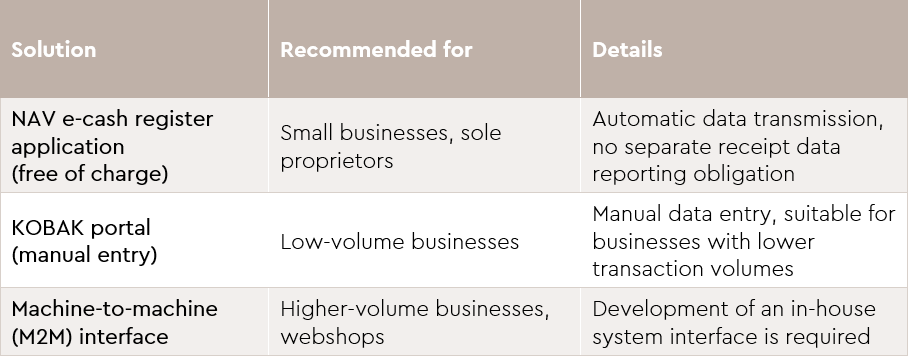
The tax authority offers several options so that each business can choose a solution that best suits its operations. The three methods of compliance are as follows:
1. Cloud-based NAV e-cash register application or transition to a hardware-based e-cash register
The cloud-based e-cash register application, available since July 2025 and capable of running on smartphones, transmits receipt data simultaneously with the issuance of the receipt. As a result, no separate receipt data reporting is required.
This solution is particularly advantageous for:
- sole proprietors,
- retailers,
- low-volume service providers,
whose activities do not require the mandatory use of an online cash register.
It is important to note that the cloud-based solution is not available to all businesses. If a business carries out an activity in Hungary that is subject to the mandatory use of an online cash register, it may only use an online cash register or a hardware-based e-cash register for that activity.
Although the transition to e-cash registers will only become mandatory from 1 July 2028, there may already be compelling reasons to switch earlier (e.g. exemption from mandatory periodic servicing, exemption from document retention obligations, etc.).
Businesses subject to the online cash register requirement could previously also be exempt from using a cash register if they issued a complete invoice for every transaction. However, this solution primarily changes the method of administration and does not necessarily reduce its volume.
2. Manual entry through the KOBAK portal
The aggregated data may also be entered manually via the web-based interface of the KOBAK portal, the External Online Data Provider System of the Hungarian tax authority. This solution may be practical for businesses with a low daily volume of receipts. However, for higher transaction volumes, it may result in a significant administrative burden and a higher risk of errors.
3. Machine-to-machine (M2M) reporting
Higher-volume businesses, webshops and online service providers may fulfil their receipt data reporting obligation via a machine interface directly from their invoicing, sales or enterprise resource planning (ERP) systems. This approach requires development work, testing, and the establishment of error-handling and control processes. However, for businesses with larger transaction volumes, it may represent the most sustainable solution, as it can significantly reduce the risk of errors arising from manual data entry.
Key deadlines for the introduction of mandatory receipt data reporting
1 September 2026: Receipt data reporting obligation enters into force
1 September 2026 to 31 December 2026: Transitional grace period
To support the implementation of the new system, the legislator has provided a transitional preparation period for affected businesses. During the grace period from 1 September 2026 to 31 December 2026, NAV will generally not impose default penalties for failures to comply with, or errors in, receipt data reporting.
However, the purpose of the grace period is not to postpone preparation. Businesses should use this period to test their processes, identify potential system deficiencies and finalise internal controls and lines of responsibility.
From 1 January 2027: General penalty rules become applicable
Following the end of the grace period, from 1 January 2027 the tax authority may apply the general sanction rules set out in the Hungarian Act on Rules of Taxation (Art.). Accordingly, in the event of non-compliance:
- a natural person taxpayer may be fined up to HUF 400,000;
- a non-natural person taxpayer may be fined up to HUF 1,000,000.
The principal risk lies not necessarily in the amount of a single penalty, but in the fact that the infringement may be recurring in nature. As a result, NAV may impose penalties repeatedly.
1 July 2028: Final deadline for the use of online cash registers
After 1 July 2028, affected taxpayers will be required to use a hardware-based e-cash register.
Correction options
Previously submitted receipt data reporting submissions may be corrected retrospectively, and there is no limitation on the number of corrections. Nevertheless, businesses should pay particular attention to the following:
- Declared first receipt number: One specific feature of the system is that this data cannot be amended. If the first receipt number is reported incorrectly, the original submission must be invalidated and a new submission containing the correct data must be filed.
- Adjustment and cancellation documents: These must be handled separately from sales receipts and reported independently, taking into account the applicable VAT rate and the signed value of the document.
For this reason, establishing appropriate record-keeping and correction procedures may be crucial for avoiding errors and potential compliance risks.
Start preparing now!
Although the obligation will only enter into force on 1 September 2026, businesses are advised to begin preparations as soon as possible. For many businesses, the transition may prove more complex than initially anticipated, due to:
- the three-day reporting deadline;
- the specific aggregation requirements;
- potential IT development needs.
While the grace period provides a valuable opportunity to test processes, businesses should assess the necessary actions even before the transitional period begins in order to ensure successful compliance.

The tax experts of WTS Klient Hungary can assist businesses in assessing whether they are affected by the new requirements, reviewing receipt issuance and related business processes, interpreting receipt data reporting obligations, and addressing the tax, accounting and compliance issues associated with the transition. Where necessary, we can also support the review of internal processes, the establishment of responsibilities and control points, the alignment of requirements between IT and business functions, and the planning and implementation support of the process and system developments required for compliance.
This article is for general information purposes only and should not be considered as advice.